
On the presence of cyanobacteria blooms in Swiss Lakes
On the presence of cyanobacteria blooms in Swiss Lakes
By Jon Pertwee
16/07/2022
This post is written as a response to an article published in the Swiss Press in which I was quoted. https://www.24heures.ch/les-cyanobacteries-inquietent-les-estivants-795561983820
There have been a lot of “knee-jerk” reactions towards the death of dogs at Lac Neuchatel. As a dog owner, I can understand the reaction, but as a scientist (admittedly in a different field) my response has been more considered, and I have investigated the causes and looked at scientific research, rather than just adhering to a blanket ban of swimming with dogs because of fear. We can never be safe, the presence of cyanobacteria in lakes is a phenomenon that has existed (According to fossil evidence) at least since the Precambrian period (Scholz, et al., 2017), but we can respond to the situation without hysteria.
According to the same paper, the increase in the use of Nitrogen (687%) and Phosphorus (348%) in fertilisers used on agricultural land, which are then washed into the lakes, is a leading cause of excessive growth, specifically, the use of Phosphorus. Other papers (Donald, et al., 2013) describe the sudden influx of these chemicals into the lakes as directly correlating with increased bacterial blooms, specifically following extreme weather events (heavy rain). (Yang, et al., 2016).
Furthermore, Davis et al. (Davis, et al., 2009, p. 720) show a correlation between high temperatures (>35C) and significant increases in bacterial growth. Wu et al. (Wu, et al., 2015, p. 29) concluded that “the cyanobacterial bloom area increased as the wind speed decreased.” This is unsurprising, as the bacteria grows strongly in clumps, and wind and waves caused by the wind have the action of dispersing the bacterial clumps.
In plain language, heavy rain washes Nitrogen and Phosphorus from farmlands into lakes, providing food for the bacteria. High temperatures encourage bacterial growth, and low winds allow the bacteria to form clumps that concentrate it into levels that are dangerous to animals and children.
If you consider the weather circumstances prior to 2nd July when a dog, unfortunately, lost its life from cyanobacteria poisoning at Plage Bonvillars, we can see a “perfect storm” of circumstances. Lac Neuchatel is surrounded by farmland, and there were nearly 10 days of heavy rain, that would have washed fertiliser into the lake. (Meteoblue, 2022) We then see an increase in temperatures and a decrease in wind speed immediately prior to the incident, which would all have encouraged the bacteria to grow. Plage Bonvillars is a lagoon, which means the shape of the waters and the direction of the wind would cause the bacteria to collect in large amounts. It is a sad situation for the dog and the owner, but it is possibly one that has been caused by the general public not understanding how to recognise dangerous situations where their animals may be in danger, and relying on official recommendations, which perhaps weren’t available at the time. (Now available at https://www.vd.ch/toutes-les-actualites/communiques-de-presse/detail/communique/cyanobacteries-dans-les-lacs-information-et-prevention-1657265133/)
A blanket ban from the Canton for allowing pets to swim, during the summer periods, is unhelpful and adds to the public perception that swimming in the summer is always dangerous. This will eventually impact on tourism and the livelihoods of those who work around and on the lakes. The levels of cyanobacteria increase and decrease daily, the official response should reflect this.
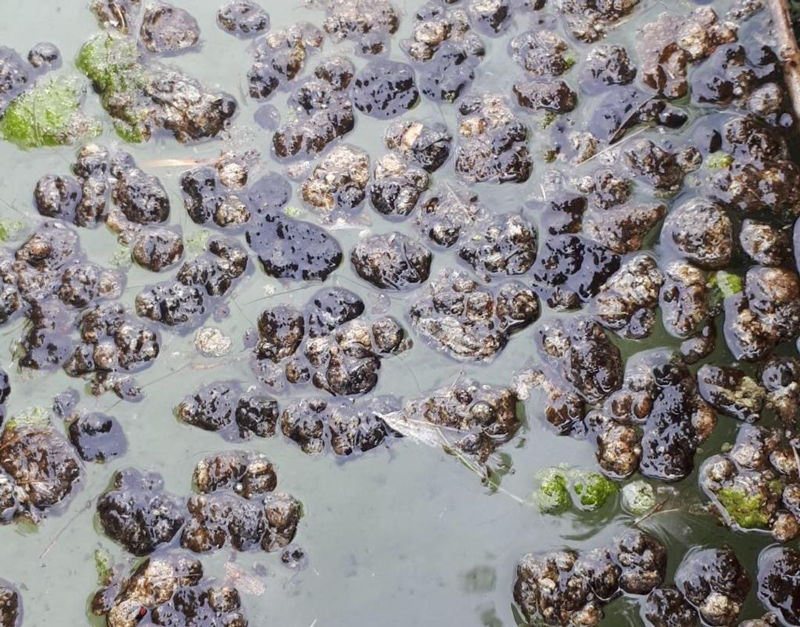
It is possible to draw some conclusions about when it might be safe for our pets to swim: if we have heavy rain followed by high temperatures and low wind, then swimming is ill-advised. If cyanobacteria are visible on the surface of the water, no matter what the weather, then swimming is ill-advised. Places such as Plage Bonvillars, where the wind is likely to blow and trap bacterial blooms in high concentrations should be avoided for animals and children.
What would be VERY useful is a regularly updated traffic light system from the Cantons affected, based on observations of the weather and of the scientific measurements or direct observations of bacterial levels. This would allow campsites and other interested parties to review or publish safe swimming guidelines on a daily basis and keep their public informed while minimising the impact on their income. Information and knowledge in the general public is essential. We are likely to see increases in summer temperatures over the coming years.
If the tourist industry around the lake is to survive, an intelligent response is needed. Hysteria caused by lack of understanding is not helpful. It would be great if there was an official, scientific response to my brief examination of the situation.
References
Davis, T., Berry, D., Boyer, G. & Gobler, C., 2009. Davis, T. W., Berry, D. L., Boyer, G. L., & Gobler, C. J. (2009). The effects of temperature and nutrients on the growth and dynamics of toxic and non-toxic strains of Microcystis during cyanobacteria blooms.. Harmful Algae, 8(5), pp. 715-725.
Donald, D. et al., 2013. Phytoplankton-Specific Response to Enrichment of Phosphorus-Rich Surface Waters with Ammonium, Nitrate, and Urea. [Online]
Available at: https://journals.plos.org/plosone/article?id=10.1371/journal.pone.0053277
[Accessed 16 07 2022].
Meteoblue, 2022. Archive météo Grandson. [Online]
Available at: https://www.meteoblue.com/fr/meteo/historyclimate/weatherarchive/grandson_suisse_2660529
[Accessed 16 07 2022].
Scholz, S. N., Esterhuizen-Londt, M. & Pflugmacher, S., 2017. Rise of toxic cyanobacterial blooms in temperate freshwater lakes: causes, correlations and possible countermeasures. Toxicological & Environmental Chemistry.
Wu, T. et al., 2015. The influence of changes in wind patterns on the areal extension of surface cyanobacterial blooms in a large shallow lake in China,. Science of The Total Environment, Volume 518-519, pp. 24-30.
Yang, Z. et al., 2016. Nutrient reduction magnifies the impact of extreme weather on cyanobacterial bloom formation in large shallow Lake Taihu (China). [Online]
Available at: https://pubmed.ncbi.nlm.nih.gov/27474940/
[Accessed 16 07 2022].